
We talk about it everywhere, but you still haven’t understood in detail, from a scientific point of view, what medical cannabis is, which varieties can be purchased in Italy, and, above all, what it does with cannabis, a medicinal plant?
Don’t worry, with this unique article, updated on November 20, 2020, you will be able to find out:
- 1. What does medical cannabis mean and what is it
- 2. Which components have a therapeutic effect
- 3. Which varieties are prescribed in Italy
- 4. How to distinguish medical cannabis strains
- 4.1 What is medical cannabis: cannabinoids
- 4.1.1 High % of THC
- 4.1.2 High % of CBD
- 4.1.3% Balanced THC:CBD
- 4.2 The terpenic profile
- 4.3 Cultivars
- 4.3.1 Indica dominance
- 4.3.2 Sativa dominance
- 5. How heat transforms cannabis
- 6. What are the effects of cannabis
- 6.1 Effects of high THC cannabis
- 6.2 Effects of high CBD cannabis
- 6.3 Effects of acidic cannabinoids
- 7. What is medical cannabis: terpenes
- 7.1 What role do terpenes play in medical cannabis
- 8. What is medical cannabis: flavonoids
- 8.1 What role do flavonoids play in medical cannabis
- 9. Final considerations from a prescribing physician
- 10. References
1. What does medical cannabis mean and what is it
The term “medical cannabis,” or more precisely called medicinal cannabis (MC), refers to the use in medicine of dried mature female inflorescences of Cannabis Sativa L. (The letter L. refers to Linnaeus, the scholar who first scientifically classified Cannabis in the 18th century, along with many other plant varieties).
MC comes from medical-grade cannabis plants grown without pesticides. Every step, from plant maintenance to packaging of the finished product, must comply with international standards of good agricultural and manufacturing practices (GACP and GMP, Agricultural and Collecting Practice and Good Manufacturing Practice).
Maximum transparency about the product is essential to meet the needs of patients, doctors, pharmacists, and regulators; this transparency is ensured by laboratory analyses conducted at various stages of production.
You can learn more about this by reading “Analysis and medical cannabis: a manual for manufacturers and pharmacists.”
2. Which components have a therapeutic effect
Cannabis is a phytocomplex; this means it contains a wide range of substances with pharmacological activity and not just a single active substance. Each strain of medicinal cannabis contains these substances in unique and distinct proportions.
The most well-known substances for their obvious medicinal qualities are cannabinoids (104 recognized to date) and terpenes (over 200 recognized in cannabis plants); but there are also other important molecules, such as flavonoids (20), amino acids, fatty acids, alkaloids, chlorophyll, etc. Andre, Christelle M., Jean-François Hausman, and Gea Warrior. “Cannabis sativa: the plant with a thousand and one molecules.” Frontiers in Plant Science 7 (2016): 19.; McPartland, John M. and Ethan B. Russo. “Cannabis extracts and cannabis: more than the sum of their parts?” Journal of Cannabis Therapeutics 1.3-4 (2001): 103-132.

Using terpenes in therapy: find out how
The number of pharmacologically active molecules contained in this medicinal plant can be daunting, making it a plant whose use is certainly complex.
To understand its application, however, there are in our support millennia of anecdotal knowledge (from folk medicine) and thousands of scientific evidence obtained from years of laboratory and clinical studies. Due to the nature of the cannabis phytocomplex, it interacts with a multitude of different receptors and cellular systems.
This quality allows medicinal cannabis to be used to treat very different symptoms, at different times of the day and in epidemiologically distinct groups of people. Knowing the components of the plant allows you to learn how to customize the MC product according to the individual, minimize side effects, and enhance therapeutic benefits.
3. Which medical cannabis varieties are prescribed in Italy
The medical cannabis varieties currently prescribed in Italy are: Bedrocan, Bedrobinol, Bediol, Bedica, Bedrolite, FM1, FM2, Pedanios. These varieties are described in the following table:
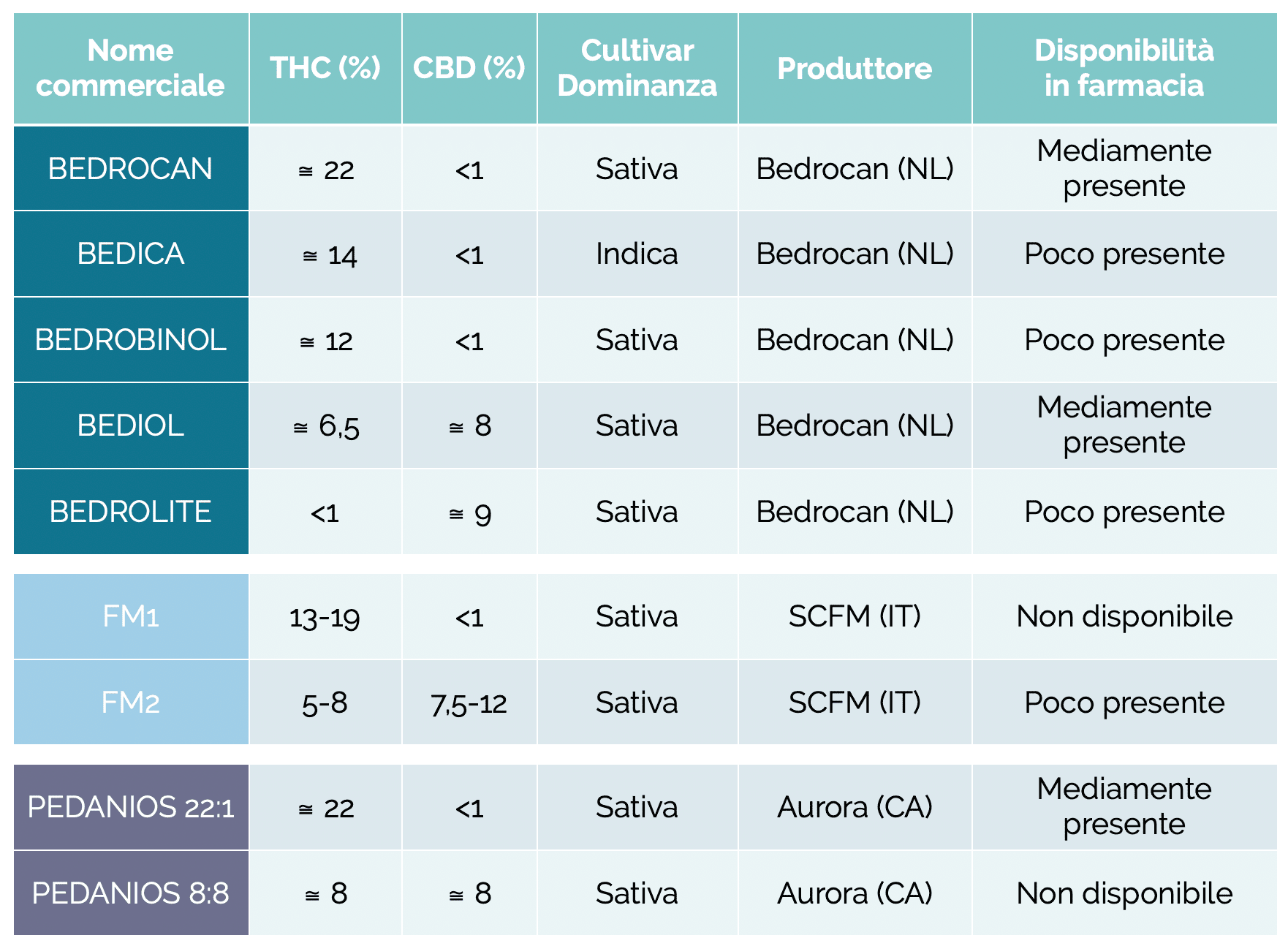
Since June 2018, FM1, the second medical cannabis variety produced at the military pharmaceutical chemical plant in Florence (SCFM), has been available in pharmacies. This is a variety that has:
- medium-high THC content with an average of 14% (allowed range of 13% to 20%)
- less than 1% cannabidiol (CBD)
It is a sativa-dominant hybrid, so it is not, as one might think from the THC title, an analogue of Bediol, but rather of Bedrobinol. The terpenic portion is also very different from the other variety produced at the plant, FM2 (THC between 5 and 8% and CBD between 7.5 and 12%).
FM1 is distributed and sold directly as a raw material from the military pharmaceutical plant to pharmacies. Like FM2, FM1 is also distributed in a ground form (about 4 mm thick) to ensure homogeneity but, unlike FM2, it is distributed in amber glass jars of 5 grams. For both varieties, distribution in pharmacies occurs under the responsibility of SCFM, at a price of €6.88 per gram, excluding VAT.
(organized by Giorgio Faggiana, Dr. Biologist at the military pharmaceutical institute in Florence)
The importation of the Pedanios 1:12 variety was canceled in September 2019 by the Ministry of Defense.
To learn more about purchasing medical cannabis from pharmacies, click here.
4. How to distinguish medical cannabis varieties
MC plants are primarily divided into varieties based on:
- cannabinoid production
- terpenic profile
4.1 What is medical cannabis: cannabinoids
Cannabinoids are lipid compounds produced by the plant for defense purposes (against free radicals, pathogens, UV rays). Cannabis plants primarily produce acidic cannabinoids or known as “pre-cannabinoids,” as they are not capable of activating classical cannabinoid receptors (in their abbreviated form, they are followed by the letter “A,” for example THCA, CBDA, CBCA, etc.). They are transformed into “neutral” cannabinoids such as THC and CBD according to a process described in the section “How heat transforms cannabis.” Dussy FE, Hamberg C, Luginbuhl M et al. Isolation of D9-THCA-A from hemp and analytical aspects regarding the determination of D9-THC in cannabis products. Forensic Sci Int 2005; 149:3 —10
4.1.1 High % of THC
Medicinal cannabis varieties sold in Italian pharmacies that contain a high concentration of THC-A (tetrahydrocannabinolic acid) are sold under the commercial names of Bedrocan, Bedrobinol, Bedica, FM1 and Pedanios 22. From these varieties, between 13 and 26% THC can be obtained.
4.1.2 High % of CBD
In contrast, medicinal cannabis strains that contain a high concentration of CBD-A (cannabidiolic acid) are sold under the commercial names of Bedrolite and Pedanios 1:9. From these strains, between 8 and 10% CBD can be obtained with THC levels below 1%.
4.1.3% Balanced THC:CBD
Bediol, FM-2 and Pedanios 8:8 are the commercial names of the MC varieties sold in Italy that contain a medium-high concentration of acidic cannabinoids (THCA and CBDA), in similar proportions, often 1:1. Between 5% THC and 12% CBD can be obtained from these strains.
4.2 What is medical cannabis: the terpenic profile
Medical cannabis varieties are also distinguished based on the terpene-phenolic profile, that is, the proportion of concentrations of molecules that give different scents (terpenes) and pigmentation (flavonoids) to the plants.
These substances play an important role in mediating or amplifying the therapeutic effects of cannabinoids, depending on the variety. Russo, Ethan B. “Taming THC: potential synergy and entourage effects of phytocannabinoid-terpenoid cannabis.” British Journal of Pharmacology 163.7 (2011): 1344-1364.
4.3 What is medical cannabis: cultivars
Cultivars are cannabis varieties selected by humans based on specific characteristics. The differences between Indica and Sativa dominant cultivars are varied. The main effects attributed to these varieties on human physiology are described below.
Level I medical cannabis
For more references on plant biology and botany, you can follow the Level I MC course where it is explained clearly and in depth by the biology researcher Dr. Luigi Romano!
4.3.1 Indica dominance
In general, the varieties indicated in Fig.1 as “Indica” identify a prevalence of analgesic and sedative effects and a more concentrated effect on the body, in accordance with a high percentage of components such as the acyclic terpene myrcene, which is believed to amplify THC through various mechanisms. Russo, Ethan B. “Taming THC: potential synergy and entourage effects of phytocannabinoid-terpenoid cannabis.” British Journal of Pharmacology 163.7 (2011): 1344-1364; Bisset NG, Wichtl M (2004). Herbal Drugs and Phytopharmaceuticals: A Handbook for Practice on a Scientific Basis, 3rd ed. Medpharm Scientific Publishers: Stuttgart; CRC Press: Boca Raton, FL.; by Vale TG, Furtado EC, Santos JG Jr, Viana GS (2002). Central effects of citral, myrcene, and limonene, constituents of essential oil chemotypes of Lippia alba (Mill.) n.e… Continue reading
In Italy, to date, only one primarily indica cultivar is distributed, namely the Bedica variety.
4.3.2 Sativa dominance
The largest number of CM varieties sold in Italy is sativa-dominant. These include varieties with the three main THC:CBD proportions described above; although the effects described below also vary depending on the cannabinoid profile of each plant.
Sativa varieties are characterized by a primarily cerebral effect. Sativa-dominant varieties are preferred for daytime activities as they generally have an energizing effect.
5. How heat transforms cannabis
The percentages presented in Figure 1 distinguish the varieties based on the proportion of “neutral” cannabinoids: the molecules of CBD (cannabidiol) and THC (tetrahydrocannabinol).
These molecules are present in very low proportions in cannabis inflorescences at the time of harvest, as they are only obtained through a transformation.
This transformation is called decarboxylation, and is nothing more than the application of a heat source around 120 °C, to allow the dispersion of the carboxyl group COOH and the conversion of acidic cannabinoid molecules into neutral cannabinoids. Hospodor, Andrew David. “Controlled decarboxylation of cannabis.” US Patent No. 8,980,941. March 17, 2015.
The percentages in figure 1 thus indicate estimated values on the total decarboxylation of products. It is therefore possible to obtain different proportions of neutral cannabinoids (THC: CBD) from the percentages presented in the table depending on the preparation method of the pharmaceutical preparer or the patient themselves, which determine the duration, temperature, and matrices in which the cannabis is decarboxylated (for example by the chosen method of administration). Veress, T., J.I Santo, and L. Leisztner. “Determination of cannabinoid acids by high-performance liquid chromatography of their neutral derivatives formed by thermal decarboxylation: I Study of… Continue reading
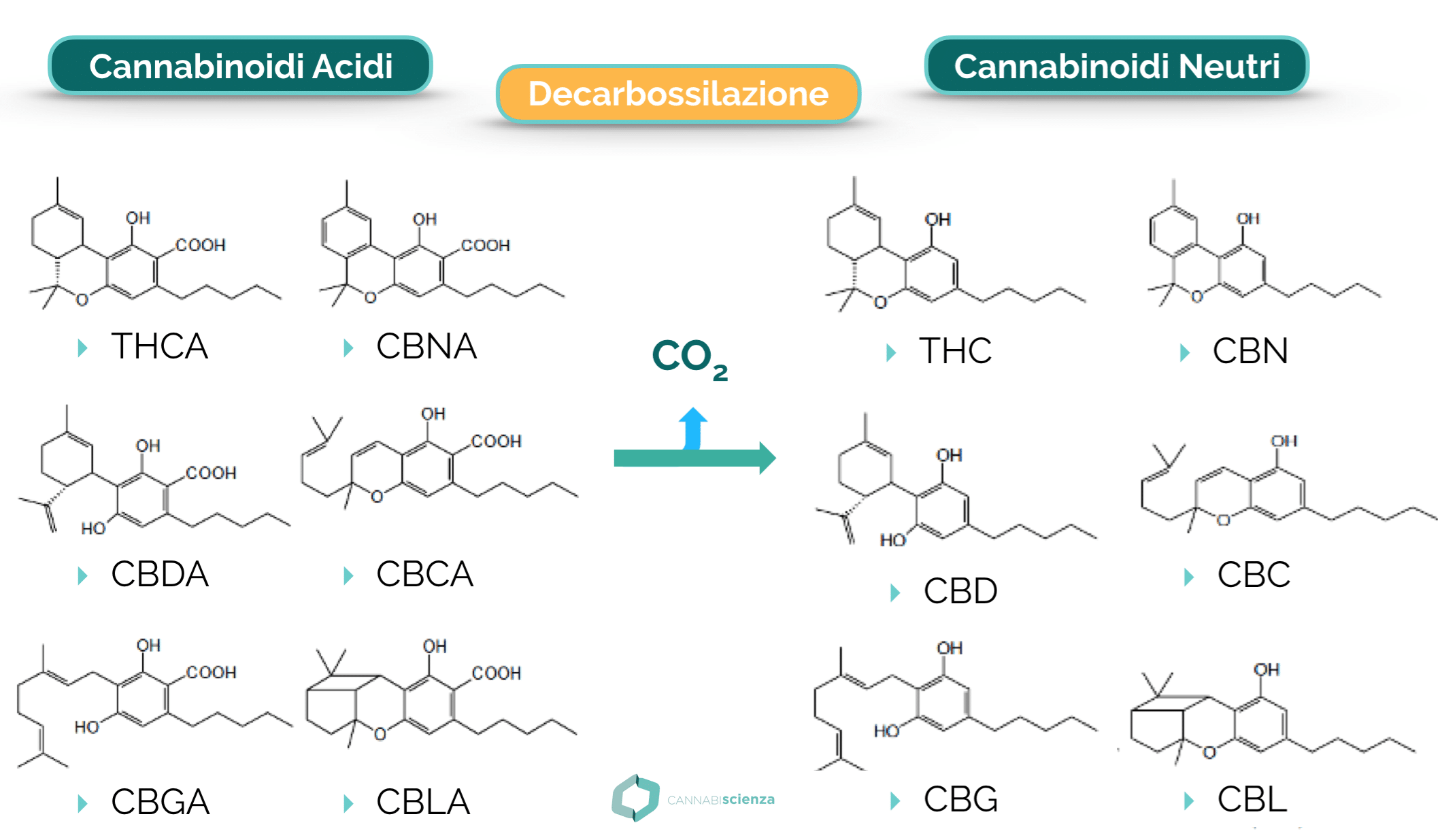 You can learn more about decarboxylation with Dr. Marco Ternelli and Professor Federica Pollastro during the course “MC for Pharmacy and Industry”
Figure 2. — Decarboxylation of cannabinoids 6. What are the effects of cannabis
6.1 Effects of high THC cannabis
Cannabis plants with high THCA can be used, after decarboxylation, to obtain medicinal cannabis with a high concentration of THC.

Δ-9 THC (and some of its isomers) are cannabinoids that induce psychotropic effects Figure 3. — THCA (non-psychotomimetic) is transformed into THC (psychotropic) after decarboxylation The or disturbances in alertness and/or mood. The higher the concentration of THC, the more pronounced the effects of this molecule are felt.
These effects include: euphoria, relaxation (including muscle relaxation), drowsiness, asthenia, analgesia, appetite stimulation, antiemetic . Grotenhermen F. Pharmacokinetics and pharmacodynamics of cannabinoids. Clinical pharmacokinetics. April 1, 2003; 42 (4): 327-60.
Medicinal cannabis with a high proportion of THC is primarily indicated for controlling spasms, pain, and increasing appetite.
Level I medical cannabis
To learn more about all the medical applications of THC, participate in the Level I MC course with Dr. Livio Luongo, researcher and lecturer in neuropharmacology.
There is a great personal variability in the effects of consuming cannabis with a high concentration of THC, and the main side effects are as follows: dizziness, tachycardia, reduced cognitive abilities, reduction of coordination and work performance, psychotic episodes or panic attacks . Ford TC, Hayley BC, Downey L.A., Parrott BC. Cannabis: an overview of its acute and chronic adverse effects and implications. Current Reviews in Drug Abuse. May 1, 2017; 10 (1): 6-18. Although these effects are acute and therefore do not last longer than THC is present in the plasma, they must be taken into account to avoid administering high THC cannabis to patients with heart disease or mental health issues that may exacerbate their symptoms. Karila, Laurent et al. “Acute and long-term effects of cannabis consumption: a review.” Current Pharmaceutical Design 20.25 (2014): 4112-4118.
A more in-depth discussion of this point can be found in “Psychiatric patients: the pros and cons of MC therapy.”
Because cannabis plants are a phytocomplex, the effects of this medicinal plant are not only determined by the concentration of THC but also by the proportion with other molecules. For example, the cannabinoid CBD and the limonene terpene attenuate asthenic and anxiogenic effects, while the cannabinoid and myrcene terpenes CBC and linalool amplify its analgesic and sedative effects. Russo, Ethan B. “Taming THC: potential synergy and entourage effects of phytocannabinoid-terpenoid cannabis.” British Journal of Pharmacology 163.7 (2011): 1344-1364.
6.2 Effects of high CBD cannabis
CBD (and its derivatives) are cannabinoids that do not induce psychotropic effects. Machado Bergamaschi, Mateus et al. “Safety and side effects of cannabidiol, a constituent of cannabis sativa.” Current Drug Safety 6.4 (2011): 237-249. Cannabis plants with high CBDA can be used, after decarboxylation, to obtain medicinal cannabis with a high concentration of CBD. Citti, Cynthia et al. “Analysis of cannabinoids in commercial hemp seed oil and kinetic studies of decarboxylation of cannabidiolic acid (CBDA).” Journal of Pharmaceutical and Biomedical Analysis 149… Continue reading
The most studied effects of CBD include anxiolytic and antipsychotic properties, neuroprotective and anti-inflammatory, analgesic, antiepileptic, antiemetic and anticancer. Whiting, Penny F., et al. “Medical cannabinoids: a systematic review and meta-analysis.” Jama 313.24 (2015): 2456-2473. High CBD medicinal cannabis is particularly used to regulate mood, control inflammatory disorders, seizures, nausea, and pain.
Depending on the disease, a higher or lower concentration of THC may be needed to alleviate its effects.
To learn more, we recommend reading this publication: “Medical cannabis varieties in Italy: a practical guide.”
6.3 Effects of acidic cannabinoids
As previously mentioned, cannabis plants naturally synthesize all cannabinoids in their acidic chemical form through enzymatic reactions. Acidic cannabinoids are the most widespread phytocannabinoids in raw (unadulterated) cannabis plants (or even “Raw Cannabis”).

Acidic cannabinoids have no psychotropic effect as they do not cross the blood-brain barrier (this network of capillaries that protects our brain), and they primarily interact with the receptor system of the periphery of the body.
Although less studied, acidic cannabinoids such as CBDA and THCA have shown their own medicinal effects (see nausea, pain, neuroprotection) and act through functional mechanisms different from those of CBD and THC. Moreno-Sanz, G (2016). “Can you pass the acid test? Critical review and new therapeutic perspectives of Δ9-tetrahydrocannabinolic acid A.” Cannabis and Cannabinoid Research 1 (1): 124—130.
7. What is medical cannabis: terpenes
Terpenes are lipid structures produced by the resins of many plants. Plants produce these secondary metabolites (essential oils) primarily for defense (against fungi, bacteria, herbivores, or environmental stress) and communication (with other plants or insects and birds).
Essential oils are recognizable because they have scents unique to the composition of the terpenes that make them up.
Cannabis plants produce different types of terpenes; they have distinct biochemical structures. Some categories of terpenes are more volatile than others and can be lost in the final medication.
The
monoterpenes, scents such as limonene or menthol, for example, are more prone to denaturation and dispersion than sesquiterpenes, which are more resistant when heated (4). administration and pharmaceutical preparations of MC, not only for the pharmaceutical preparer but also for the prescribing physician and for the patient or caregiver.

Monoterpenes and sesquiterpenes of cannabis 7.1 What role do terpenes play in medical cannabis
Each terpene has distinct medical properties due to its interaction with its own receptors and/or enzymatic pathways. Russo, Ethan B. “Taming THC: potential synergy and entourage effects of phytocannabinoid-terpenoid cannabis.” British Journal of Pharmacology 163.7 (2011): 1344-1364. This fruitful combination has allowed ethnopharmacological studies, despite the existing limits on medications, to derive scientific data on these molecules over the years and identify the functional mechanisms and medicinal properties of a large number of terpenes present in medicinal cannabis. . Studies, combined with anecdotal experience from patients worldwide, allow us to recognize the terpenic profiles of medical cannabis and begin to distinguish them based on treatment needs.
Terpenes can modulate cannabinoids in a synergistic relationship that has been widely discussed in the scientific literature and called the “entourage effect.” André, Christelle M., Jean-François Hausman, and Gea Warrior. “Cannabis sativa: the plant with a thousand and one molecules.” Frontiers in Plant Science 7 (2016): 19.; McPartland, John M. and Ethan B. Russo. “Cannabis extracts and cannabis: more than the sum of their parts?” Journal of Cannabis Therapeutics 1.3-4 (2001): 103-132.; Russo, Ethan B. “Taming THC: potential synergy and entourage effects of phytocannabinoid-terpenoid cannabis.” British Journal of Pharmacology 163.7 (2011): 1344-1364.
Terpenes easily cross the blood-brain barrier and help cannabinoids do the same. They can also modulate the effects of cannabinoids directly at the site of their receptors. McPartland, John M. and Ethan B. Russo. “Cannabis extracts and cannabis: more than the sum of their parts?” Journal of Cannabis Therapeutics 1.3-4 (2001): 103-132.; Russo, Ethan B. “Taming THC: potential synergy and entourage effects of phytocannabinoid-terpenoid cannabis.” British Journal of Pharmacology 163.7 (2011): 1344-1364. In this regard, we recommend reading the text: “Myrcene: discovering anti-inflammatory and analgesic activities.”
Some terpenes modify the liver’s speed to metabolize cannabinoids, thus increasing their bioavailability.
Others, like β-caryophyllene, directly activate cannabinoid receptors (CB2) acting as true “dietary cannabinoids.” Gertsch, Jürg et al. “Beta-caryophyllene is a dietary cannabinoid.” Proceedings of the National Academy of Sciences 105.26 (2008): 9099-9104.
Here you can read: “Caryophyllene: Anti-inflammatory effects of a dietary cannabinoid.”
Finally, terpenes such as limonene have antioxidant and anti-tar activities, protecting smokers from the risk of cancer. Although the combustion of cannabis is still not recommended for medicinal purposes, it is tolerated in terminally ill patients.
Medical cannabis
Follow the in-depth study on personalized medicine with Dr. Lorenzo Calvi, ethnopharmacologist and physician specializing in pain treatment during the medical cannabis course.
8. What is medical cannabis: flavonoids
Flavonoids are secondary metabolites commonly produced by many plants. Plants secrete flavonoids to protect themselves against oxidative stress, pathogens, and ultraviolet (UV) rays. Cannabis, like many other plants, produces flavonoids: more than twenty have been identified.
Unlike cannabinoids and terpenes, which are primarily present in the inflorescences of the cannabis plant, flavonoids have been found both in the flowers and also in the leaves and stem of the plant.
Some cannabis flavonoids are common with other plants: apigenin, vitexin, kaempferol, quercetin, luteolin, for example. Other flavonoids (Cannflavin A, B, C) and lignans (Cannabisin A, B, C, D, E, F) are unique to
this plant. Clark MN, Bohm BA. Flavonoid variation in Cannabis L. Botanical Journal of the Linnean Society. October 1, 1979; 79 (3): 249-57. In some cannabis strains, cannflavins, in addition to being present in the aforementioned parts, are produced by the plant already during bud formation. ElSohly, Mahmoud A. Chemical constituents of marijuana: The complex mixture of natural cannabinoids. Haworth Press, New York, 2005.
8.1 What role do flavonoids play in medical cannabis
Flavonoids have a known antioxidant and anti-inflammatory action; some of them have adjuvant properties in certain pathological states as well as in prevention.
Furthermore, flavonoids are capable of acting at the level of cytochromes by modulating the absorption, distribution, metabolism, and elimination of cannabinoids from the body. McPartland, John M. and Ethan B. Russo. “Cannabis extracts and cannabis: more than the sum of their parts?” Journal of Cannabis Therapeutics 1.3-4 (2001): 103-132.
To learn more, we recommend reading “Flavonoids in medical cannabis.”
9. Final considerations from a prescribing physician
Dr. Lorenzo Calvi, surgeon, specialist in anesthesia, resuscitation, and pain treatment, and in ethnopharmacology and cannabis research at the University of Milan, Department of Agriculture, states
“MC contains the phytocomplex with active principles, with pharmacological activity. The most interesting active ingredient is delta-9-tetrahydrocannabinol (or THC), a psychotropic substance, considered by Italian laws as a narcotic. In recent years, other non-psychotropic components of cannabis, such as cannabidiol (CBD), other “minor cannabinoids” (such as THCV, THCA, CBDA) and terpenoids, are becoming increasingly relevant in the medicinal field.
Currently, in Italy, the therapeutic use of narcotics is allowed, provided that they are prescribed by doctors with a non-reproducible prescription. The role of the healthcare professional remains fundamental and central in the process, who can only prescribe cannabis after a thorough visit and interview with the patient, providing all necessary information, formulating a personalized treatment plan tailored to the specific pathology and clinical condition of the patient, dosage, and prevention as much as possible of side effects and undesirable effects that may occur.”
Dr. Lorenzo Calvi
Learn to prescribe with Dr. Calvi in the course dedicated to doctors and therapists: MC Clinic
ORIENTATION
Within 2 working days, a scientific informant will contact you to guide you to the most appropriate training path.
Please provide us with your contact details.
Course/Master of Interest/Level I medical cannabis/Endocannabinoid system/Clinical medical cannabis/Medical cannabis/Medical cannabis/Master CM and clinical applications/Master CM and pharmaceutical preparations/Cannabis and food/Medical cannabis in clinical practice (ECM) Medical cannabis in pharmaceutical practice (ECM) I consent to the processing of my data as required by the privacy policy* (mandatory) I wish to subscribe to the newsletter







CANNABISCIENCE IS SPONSORED BY:
References
| ↑ 1, ↑ 19 | André, Christelle M., Jean-François Hausman, and Gea Guerriero. “Cannabis sativa: the plant with a thousand and one molecules” Frontiers in plant science 7 (2016): 19. |
|---|---|
| ↑ 2, ↑20, ↑22, ↑ 27 | McPartland, John M. and Ethan B. Russo. “Cannabis extracts and cannabis: more than the sum of their parts?” Journal of Cannabis Therapeutics 1.3-4 (2001): 103-132. |
| ↑ 3 | Dussy FE, Hamberg C, Luginbuhl M et al. Isolation of D9-THCA-A from hemp and analytical aspects regarding the determination of D9-THC in cannabis products. Forensic Sci Int 2005; 149:3 —10 |
| ↑ 4, ↑5, ↑13, ↑18, ↑21, ↑23 | Russo, Ethan B. “Taming THC: potential synergy and entourage effects of phytocannabinoid-terpenoid cannabis.” British journal of pharmacology 163.7 (2011): 1344 -1364. |
| ↑ 6 | Bisset NG, Wichtl M (2004). Herbal Drugs and Phytopharmaceuticals: A Handbook for Practice on a Scientific Basis, 3rd ed. Medpharm Scientific Publishers
CBD Flowers: What Are Their Effects on Health?
Read alsoDiscover the Richness of Breton Leisure: Activities, Traditions, and Must-See OutingsOn the northern coast, a sand yacht instructor plants his wheels in the wet sand of the Bay of Saint-Brieuc while… Complete guide to successfully implementing an effective document management solutionAn accounting service that spends its mornings searching for invoices in poorly named shared folders, a design office whose plans circulate... Fun game and toy ideas to support your child’s developmentAn eighteen-month-old child who tirelessly empties a bucket of wooden blocks and then puts them back one by one: this repetitive action engages fine motor skills, hand-eye coordination, and understanding of volume. Choosing games and… |