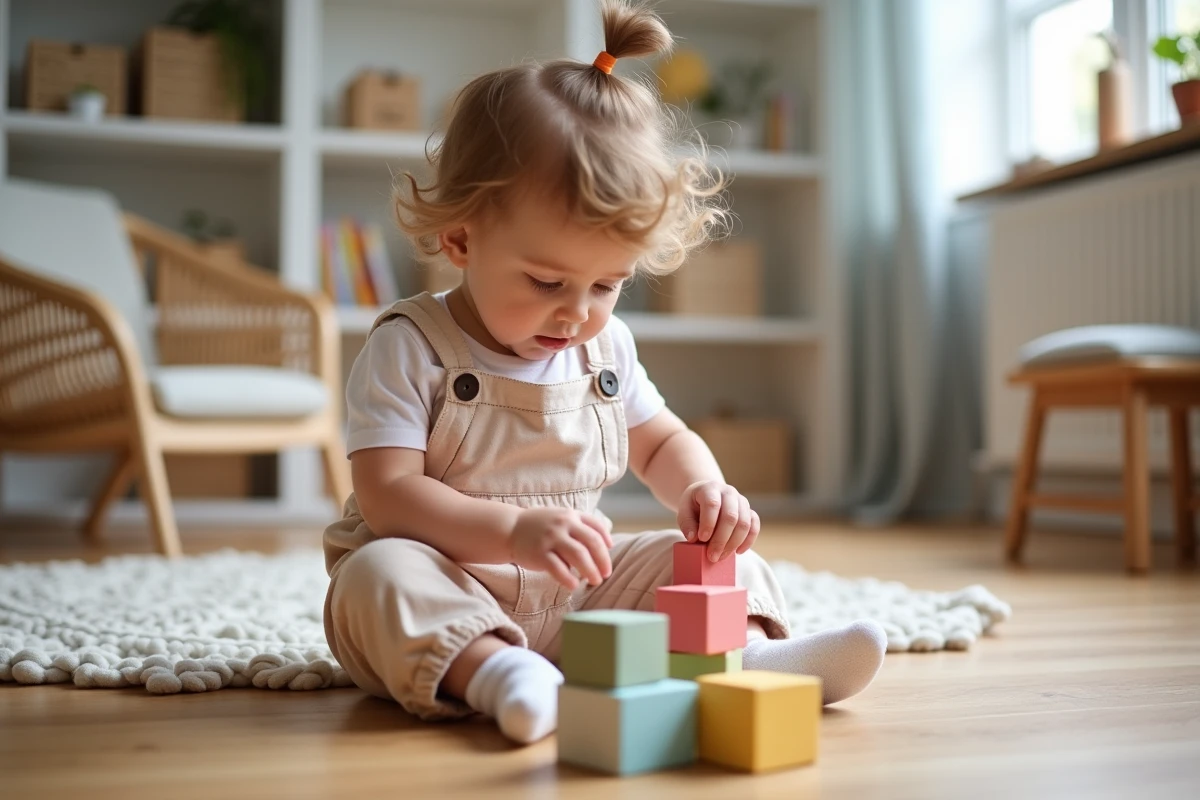
An eighteen-month-old child tirelessly empties a bucket of wooden blocks and then puts them back one by one: this repetitive action engages fine motor skills, hand-eye coordination, and understanding of volume. Choosing playful games and toys to support your child’s development involves identifying which motor and cognitive skills you want to nurture, and then selecting the appropriate tools. It can be overwhelming in the crowded aisles, so it’s best to start from concrete situations.
Hybrid developmental toys: when sound enriches manipulation
Competitors often talk about categories (motor skills, sensory, shapes and colors), but one segment is gaining ground without being thoroughly addressed: hybrid toys that combine physical manipulation and sound feedback. Think of figurines that make a sound when the child places them on a base, or interactive cubes that respond to stacking.
The benefits are twofold. Immediate auditory feedback reinforces the cause-and-effect loop for the child, and the manipulation remains physical, preserving fine motor skill development. This way, we avoid the pitfall of passive screens while adding a layer of stimulation.
To explore this type of toy suitable for each age group, the range dedicated to children on the Ouaps site offers references that combine sound interaction and manipulation play, from infancy to older children.
A point of caution: feedback varies in terms of actual attention span depending on the model. A toy that is too chatty can overwhelm the child. It’s better to favor short sound feedback triggered by the child’s action rather than a continuous musical loop.

Selection criteria for a wooden or plastic developmental toy
Before choosing between a solid wood game and a soft plastic toy, it’s beneficial to ask three concrete questions. These help avoid impulsive purchases and quick boredom.
- Modularity of the toy: can it be used in multiple ways as the child grows (stacking, sorting, rolling), or is its use fixed to a single action?
- Resistance to rotation: in daycare, a toy passes through dozens of hands each week. At home, the pressure is less, but a toy that falls apart at the first bump quickly loses its appeal. Raw wood withstands impacts better, while plastic handles moisture better.
- Attention span suitable for age: a six-month-old baby focuses for a few minutes. A toy that is too complex for their motor stage will be ignored and then forgotten in a box. Choose a level of difficulty slightly above what the child already masters, not two levels above.
This simple filter works equally well for a newborn rattle and a shape-sorting game intended for two to three-year-olds.
Wood vs plastic: a false debate
It’s often said that wood is superior for sensory development. In practice, the material matters less than the design of the toy. A poorly sanded wooden cube with sharp edges has no advantage over a well-designed plastic toy with varied textures.
What makes the difference: weight (a wooden object provides better proprioceptive feedback to the child), the size of the pieces relative to the hand, and the absence of small detachable parts before the age of three.
Development without purchase: everyday objects and free activities
Accumulating toys is not a strategy for development. A few well-chosen household items can stimulate as much as specialized materials, provided you know what to offer and when.
An inox strainer and soft pipe cleaners are enough for a fine motor skills exercise from eighteen months. The child threads the pipe cleaners through the holes, removes them, and repeats. This action engages the thumb-index pinch and bilateral coordination.
A bin of rice or semolina with cups of different sizes effectively replaces a store-bought pouring game. The child explores volume, weight, and granular texture. Supervision is needed to prevent ingestion, but the cost is zero.
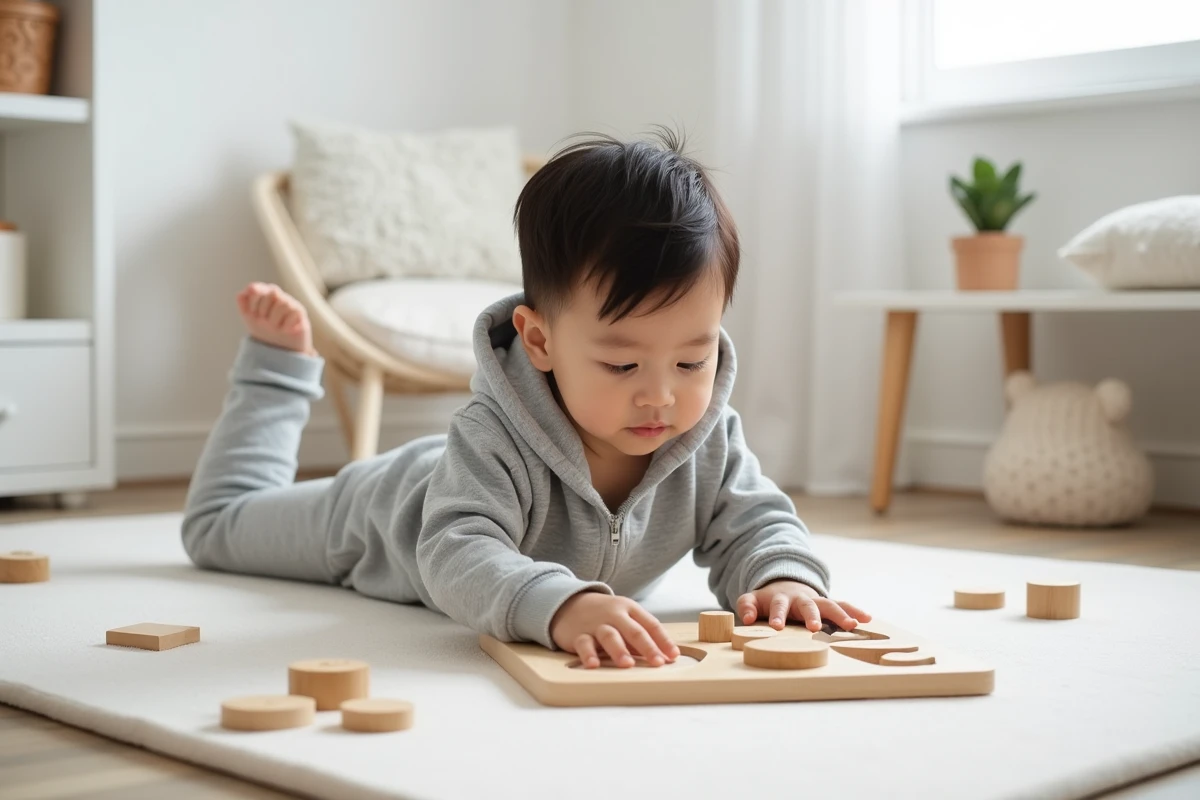
Adapting the activity to the time of day
One point that developmental guides rarely address: the child’s fatigue level drastically changes their receptivity. Offering a complex construction game just before nap time guarantees frustration.
Calm activities (playdough, touch-and-feel books, small amounts of water play) work better late in the morning or after snack time. More dynamic games (motor obstacle courses with cushions, soft ball games) are best after a rest period.
Developmental toys in group settings vs home use
The same toy does not function the same way in daycare as it does in a living room. In a group setting, the ambient noise level reduces the effectiveness of toys with auditory feedback. Educators prefer visual and tactile games, which are more discernible in a noisy environment.
At home, the child has a quieter space and the attention of an adult. Interactive toys with sound feedback make the most sense in this individual context, as the child clearly perceives the consequence of their action.
Rotating toys is an underestimated lever. Removing half of the accessible toys for two weeks, then reintroducing them, reignites curiosity and attention span. This is a common practice in childcare settings and easily applicable at home.
Choosing games to support a child’s development is not about quantity or price. A toy well-suited to the developmental stage, offered at the right time, in an appropriate environment, leads to more learning than a shelf full of references never used. The most reliable filter remains observation: watching what the child does spontaneously with an object, then adjusting accordingly.